- java.lang.Object
-
- org.apache.juddi.api.impl.AuthenticatedService
-
- org.apache.juddi.api.impl.UDDIReplicationImpl
-
- All Implemented Interfaces:
- Remote, UDDIReplicationPortType
public class UDDIReplicationImpl
extends AuthenticatedService
implements UDDIReplicationPortType
UDDI Replication defines four APIs. The first two presented here are used to perform replication and issue notifications. The latter ancillary APIs provide support for other aspects of UDDI Replication.- get_changeRecords
- notify_changeRecordsAvailable
- do_ping
- get_highWaterMarks
- Author:
- Alex O'Ree
-
-
Field Summary
-
Fields inherited from class org.apache.juddi.api.impl.AuthenticatedService
AUTHTOKEN_ACTIVE, AUTHTOKEN_RETIRED, baseUrl, baseUrlSSL, ctx, df, UTF8
-
-
Constructor Summary
Constructors Constructor and Description UDDIReplicationImpl()
-
Method Summary
All Methods Instance Methods Concrete Methods Modifier and Type Method and Description StringdoPing(DoPing body)This UDDI API message provides the means by which the current existence and replication readiness of a node may be obtained.ChangeRecordsgetChangeRecords(GetChangeRecords body)The get_changeRecords message is used to initiate the replication of change records from one node to another.List<ChangeRecordIDType>getHighWaterMarks()This UDDI API message provides a means to obtain a list of highWaterMark element containing the highest known USN for all nodes in the replication graph.voidnotifyChangeRecordsAvailable(NotifyChangeRecordsAvailable body)this means that another node has a change and we need to pick up the change and apply it to our local database.voidtransferCustody(TransferCustody body)transfers custody of an entity from node1/user1 to node2/user2 assume this node is node 2.-
Methods inherited from class org.apache.juddi.api.impl.AuthenticatedService
getEntityPublisher, getNode, getRequestorsIPAddress, setContext
-
-
-
-
Method Detail
-
doPing
public String doPing(DoPing body)
              throws DispositionReportFaultMessage
Description copied from interface:UDDIReplicationPortTypeThis UDDI API message provides the means by which the current existence and replication readiness of a node may be obtained.- Specified by:
doPingin interfaceUDDIReplicationPortType- Parameters:
body-- Returns:
- Throws:
DispositionReportFaultMessage- Since:
- 3.3
-
getChangeRecords
public ChangeRecords getChangeRecords(GetChangeRecords body)
                               throws DispositionReportFaultMessage,
                                      RemoteException
Description copied from interface:UDDIReplicationPortTypeThe get_changeRecords message is used to initiate the replication of change records from one node to another. The caller, who wishes to receive new change records, provides as part of the message a high water mark vector. This is used by the replication source node to determine what change records satisfy the caller’s request.More specifically, the recipient determines the particular change records that are returned by comparing the originating USNs in the caller’s high water mark vector with the originating USNs of each of the changes the recipient has seen from others or generated by itself. The recipient SHOULD only return change records that have originating USNs that are greater than those listed in the changesAlreadySeen highWaterMarkVector and less than the limit required by either the responseLimitCount or the responseLimitVector.
In nodes that support pre-bundled replication responses, the recipient of the get_changeRecords message MAY return more change records than requested by the caller. In this scenario, the caller MUST also be prepared to deal with such redundant changes where a USN is less than the USN specified in the changesAlreadySeen highWaterMarkVector.
The response to a get_changeRecords message is a changeRecords element. Under all circumstances, all change records returned therein by the message recipient MUST be returned sorted in increasing order according to the recipient’s local USN.
A node that is ready to initiate replication of change records held at another node within the registry uses the get_changeRecords message. Part of the message is a high water mark vector that contains for each node of the registry the originating USN of the most recent change record that has been successfully processed by the invocating node. The effect of receiving a get_changeRecords message causes a node to return to the calling node change records it has generated locally and processed from other nodes constrained by the directives of the high water mark vector specified. As such, by invoking get_changeRecords a node obtains from its adjacent node all change records (constrained by the high water mark vector) the adjacent node has generated locally or successfully processed from other nodes participating in the replication topology. What constitutes an adjacent node is governed by the replication communication graph. Replication topology is controlled via a Replication Configuration Structure. Amongst other parameters, the Replication Configuration Structure identifies one unique URL to represent the replication point, soapReplicationURL, of each of the nodes of the registry.
- Specified by:
getChangeRecordsin interfaceUDDIReplicationPortType- Returns:
- returns java.util.List
A node will respond with the corresponding changeRecords. - Throws:
DispositionReportFaultMessageRemoteException
-
getHighWaterMarks
public List<ChangeRecordIDType> getHighWaterMarks()
                                           throws DispositionReportFaultMessage
This UDDI API message provides a means to obtain a list of highWaterMark element containing the highest known USN for all nodes in the replication graph. If there is no graph, we just return the local bits- Specified by:
getHighWaterMarksin interfaceUDDIReplicationPortType- Returns:
- Throws:
DispositionReportFaultMessage
-
notifyChangeRecordsAvailable
public void notifyChangeRecordsAvailable(NotifyChangeRecordsAvailable body)
                                  throws DispositionReportFaultMessage
this means that another node has a change and we need to pick up the change and apply it to our local database.- Specified by:
notifyChangeRecordsAvailablein interfaceUDDIReplicationPortType- Parameters:
body-- Throws:
DispositionReportFaultMessage
-
transferCustody
public void transferCustody(TransferCustody body)
                     throws DispositionReportFaultMessage
transfers custody of an entity from node1/user1 to node2/user2 assume this node is node 2. user1 on node1 requests a transfer token. node 1 issues the token. user1 now has a transfer token for their stuff user now takes the token to node 2 and calls transferEntities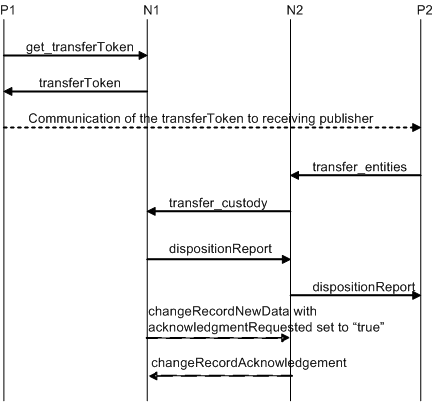
- Specified by:
transferCustodyin interfaceUDDIReplicationPortType- Parameters:
body-- Throws:
DispositionReportFaultMessage
-
-